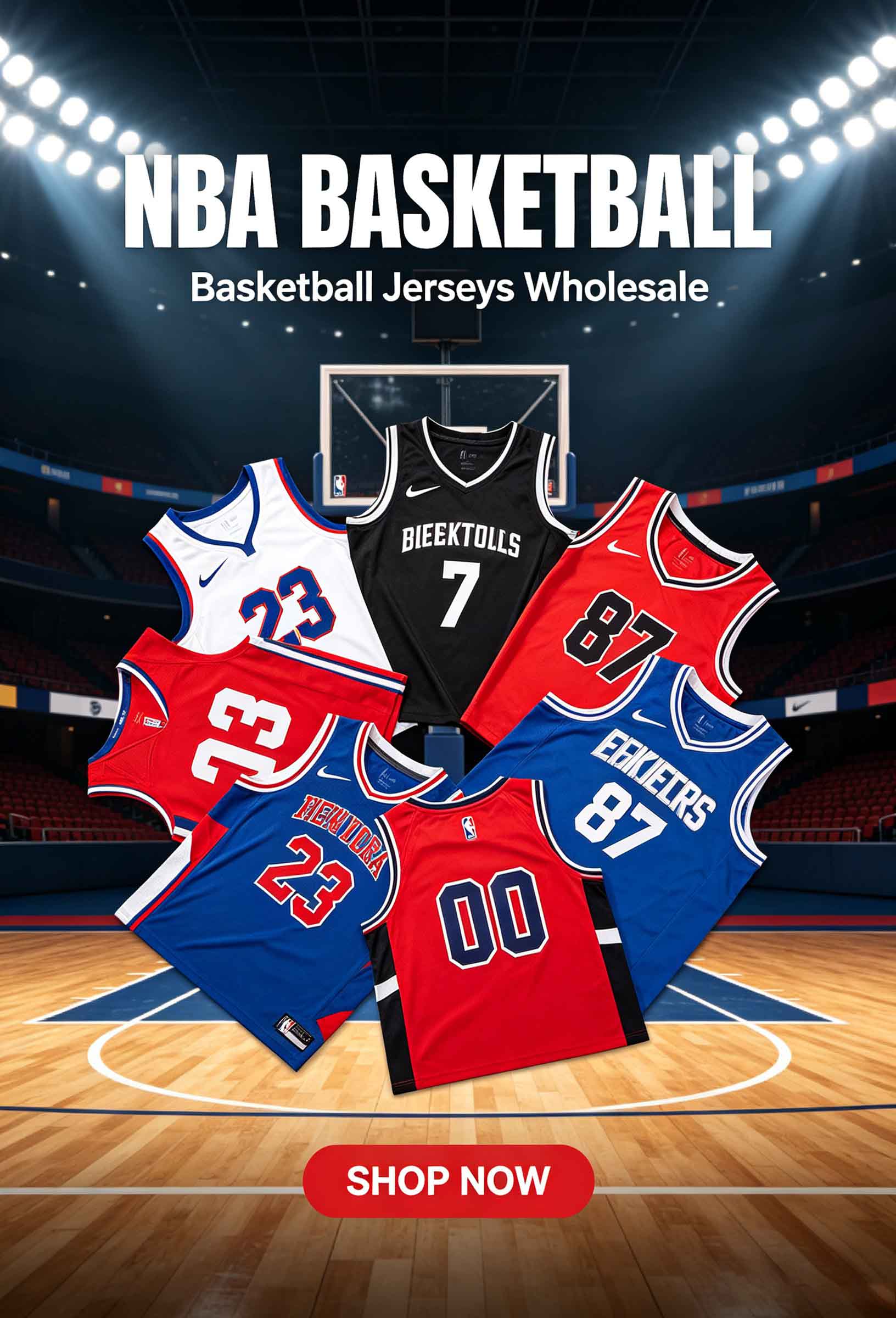
If you are sourcing team gear for a pro shop, a youth league, or a regional reseller network, the question of the best fabric for NFL jerseys decides your return rate, your repeat orders, and your margins. This guide breaks down what actually holds up across a full season of Sunday wear and what you should demand from a wholesale partner before you wire a deposit.
Most buyers get burned the same three ways. They split one purchase order across four or five small suppliers, so freight costs balloon and no single invoice hits the discount tier. They get a sample that feels great, then receive production units made from a different knit weight with thinner embroidery. Or the sizes they need most get cut from the run and they are left short on the popular numbers going into a playoff push.
Fabric is the first thing to lock down. A jersey that will survive real use starts with 100% breathable polyester mesh, typically in the 280 to 320 GSM range. Below 260 GSM, the mesh feels papery, snags on bleachers, and loses shape after a handful of washes. At 300 GSM, the drape is substantial without turning stiff, and air still moves through the panel openings.
Ask your supplier for the actual knit weight in writing. Suppliers who hedge with words like "premium mesh" instead of a number are usually selling whatever the mill had on hand that month. A Hub that stocks full categories keeps consistent spec across restocks, so your reorder in March matches the batch you sold in September.
Stitch work separates a jersey that sells once from one that builds a customer base. Look for double-stitched Tackle Twill numbers on the front, back, and shoulders. That means two layers of twill fabric, precision-cut, then sewn down with a tight perimeter stitch and a zigzag reinforcement pass on the interior edges.
Single-layer printed numbers are cheaper and that is exactly what they look like under retail lighting. Twill has depth, holds color through repeated laundering, and resists the cracking that kills screen-printed graphics after ten wash cycles.
Names and letters should follow the same standard. Block lettering in stitched twill, aligned to a consistent baseline across the whole run, with no puckering where the fabric shifts under the needle. Puckering is the single clearest signal of a factory running too fast without proper backing.
Comfort details matter more than buyers expect, because they drive reviews and reviews drive reorders. The best units include a soft interior backing behind every embroidered zone, so the thread tails never scratch the wearer's skin or snag an undershirt.
Collar construction is another tell. Reinforced collar bands with a ribbed knit and a double-stitched attachment keep the neckline from stretching into a sagging oval after a season of pull-on wear. Cheap collars go wavy within a month.
Side seams should be locked with a Z-stitch reinforcement at the underarm and hem stress points. Those are the two spots that tear first when a jersey gets pulled on and off constantly, and they are cheap to reinforce during production but impossible to fix later.
Hem and sleeve finishes should have a clean twin-needle stitch with no loose threads. Run your hand along the inside of the seam. If you feel raw thread ends or a rough overlock edge, the finishing station skipped a step.
Now consider how you buy. Consolidating into one hub is not just convenient, it is a direct margin move. One purchase order means one freight charge, one customs entry, and one quality standard across every team and every size you carry.
- Single shipping lane: one consolidation reduces per-unit freight versus four separate parcels from four factories.
- Consistent spec: the same mesh weight and twill standard across all SKUs you stock.
- Size depth: you can fill odd size gaps in one order instead of paying minimums at three vendors.
- Tiered pricing: order volume pools across categories, so mixed-team orders still climb the discount ladder.
Ask any potential supplier how they handle a mixed order of NFL, MLB, NBA, and NHL stock in one shipment. If the answer involves multiple production timelines and separate freight quotes, you are working with a broker, not a hub.
Quality control on a bulk run needs a written sampling plan. Standard practice is an AQL inspection tiered by order size, pulling units at random and checking the same five points every time.
- Stitch density: count stitches per inch on the twill perimeter; anything under 8 per inch will unravel.
- Color match: verify team colors against the approved swatch under daylight, not just warehouse lighting.
- Measurement check: flat-lay chest and body length against the spec sheet, size by size.
- Backing inspection: confirm soft interior backing is present on every embroidered panel.
- Thread trim: no loose ends over 3mm anywhere on the garment.
A hub that lets you request third-party inspection before the cartons leave the floor is a hub that expects its output to pass. That is a reasonable ask and a fast way to filter suppliers.
Sizing is where wholesale buyers lose money quietly. Football jerseys are cut oversized by design, and if your size chart does not match the actual garment, you get returns that eat the entire margin on that unit. Always request a measured flat-lay chart, not a body measurement chart.
For most adult runs, the demand curve sits heavily on L and XL, with a long tail in 2XL and 3XL. Youth sizing moves fastest right before a season starts. If you are stocking a youth program, order the middle youth sizes deepest and treat the extremes as fill-in.
Mixing sizes inside a single case is a real advantage when you are supplying a league. Rather than buying a full case of one size, you want a supplier who will build assorted cases by size ratio. That keeps your inventory balanced and your cash out of dead sizes.
Stock depth is the other half of the equation. A supplier with shallow inventory will take your order, then tell you two weeks later that a specific size is unavailable because it was never actually on the shelf.
Look for a partner that publishes live stock counts by team, size, and colorway. Real-time visibility means you can commit to a customer delivery date with confidence instead of padding every quote with a two-week buffer.
For resellers running drop-ship or marketplace listings, in-stock depth is what protects your seller rating. Late shipments on sports gear hit hardest during the playoff window when buyers are least patient.
Where should you start? A serious wholesale operation carries the full American sports catalog in one warehouse, with bulk stitched NFL football jerseys sitting alongside baseball, basketball, and hockey stock so you can build a mixed order and still hit volume pricing.
Pricing should follow a published ladder. Know the unit cost at your current tier, and know exactly what quantity moves you to the next one. Vague "contact us for pricing" language on a wholesale page usually means the price depends on how you look when you ask.
Now consider care guidance, because it protects your end customer and reduces complaints. Pass these instructions along with every order you ship.
- Wash cold, inside out: heat is what breaks down polyester fibers and fades dyed twill.
- Skip the dryer: hang or lay flat; tumble heat shrinks mesh and dulls embroidery thread.
- No fabric softener: it coats the mesh and reduces breathability.
- Iron on low, never directly on twill: press through a cotton cloth or from the inside only.
- Store folded, not on wire hangers: wire leaves shoulder dimples in heavy mesh.
Ironing is the most common question, and the answer is straightforward. Turn the jersey inside out, set the iron to the lowest synthetic setting with no steam, and press through a thin cotton towel. Never touch the iron directly to stitched twill, because the twill will glaze and the thread will melt.
Fading is mostly a laundering problem, not a fabric problem. Cold water, inside-out washing, and air drying will keep colors sharp for years on a properly dyed garment. If a jersey fades within a season, the dye process was cut short at the mill.
One more sourcing point for team buyers. If you run a league or a corporate sports program, you need a supplier who can handle roster-based orders where every unit carries a different number and name.
Batch customization is where small factories fall apart. Ask how they handle a 40-unit order with 40 unique name and number combinations, and ask to see their internal proofing process. A hub with a proper production line will give you a name-and-number proof sheet before anything gets stitched.
Turnaround on custom runs is worth negotiating up front. Standard production for stitched customization typically runs two to four weeks after proof approval, and longer during the pre-season rush. Lock your date in writing.
Payment terms are also negotiable once you have order history. First orders usually run on deposit, but repeat buyers with a clean record can often move to partial-shipment or net terms. Ask, do not assume.
Before committing, request a mixed sample pack covering one team from each major league. Inspect the mesh under natural light, check the stitch density, feel the interior backing, and measure the flat-lay against the spec sheet. A supplier confident in their output will ship samples without hesitation.
Then test the small order before the big one. Place a modest first purchase, confirm the packing accuracy and the delivery window, and only then scale into a full seasonal buy. That sequence protects your capital and tells you exactly what a supplier is worth.
FAQ
What GSM mesh should I expect on a quality football jersey?
Aim for 280 to 320 GSM breathable polyester mesh. Anything under 260 GSM feels thin, snags easily, and loses shape. Confirm the weight in writing before ordering.
Are stitched jerseys worth the higher unit cost over printed ones?
Yes, for resale. Double-stitched Tackle Twill numbers survive repeated washing without cracking, hold perceived value on the shelf, and generate fewer returns. Printed graphics fail first and cost you the customer.
Can I mix teams and leagues in one wholesale order and still get volume pricing?
With a true hub, yes. Order volume should pool across categories so a mixed order of NFL, MLB, NBA, and NHL stock still climbs to your discount tier. Confirm this policy before you build the order.
How long does custom name and number production take?
Plan on two to four weeks after you approve the proof sheet. Expect longer during the pre-season window. Get the ship date written into the order confirmation.
Stop managing five vendors and five freight invoices for one season of stock. The Jerseys Wholesale Hub catalog carries stitched football, baseball, basketball, and hockey inventory under one roof with tiered bulk pricing, low opening minimums, and consolidated fast freight. Browse the full warehouse line at www.jerseyswholesalehub.com and lock your order before the next rush hits.