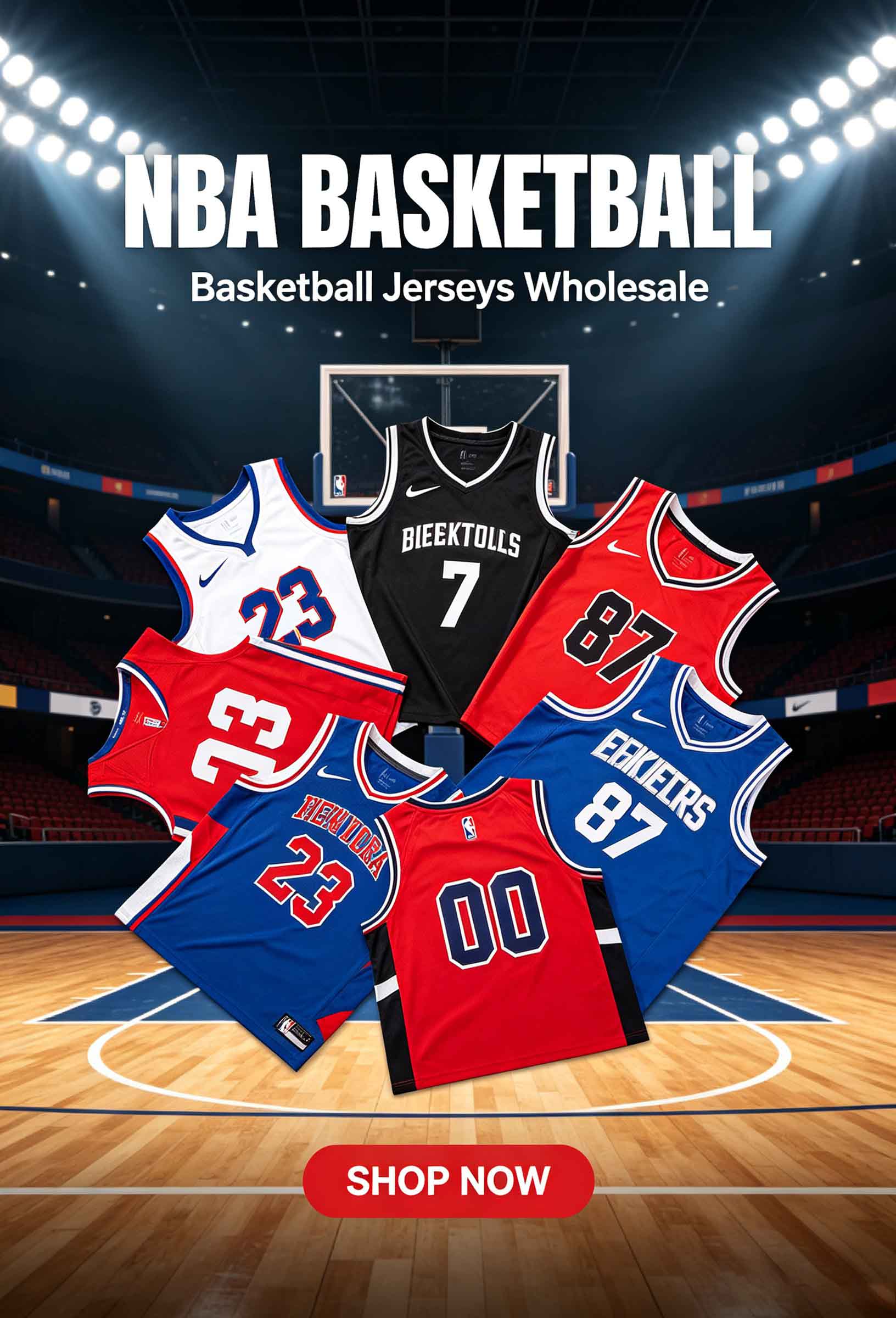
Sourcing the best fabric for NFL jerseys is less about brand hype and more about what survives a season of resale and wear. Most bulk buyers learn this the hard way after splitting orders across three or four suppliers and ending up with mismatched mesh weights, peeling numbers, and late shipments. The real cost is not the unit price—it is the returns, the chargebacks, and the reorders you lose when a team manager opens a carton and finds half the jerseys cut from thinner cloth than the sample. Jerseys Wholesale Hub exists to close that gap with one warehouse, one quality standard, and one freight plan.
Fabric weight is the first filter, because it drives everything downstream. A pro-grade NFL jersey body sits around 300 GSM, a heavyweight mesh that holds its shape on a hanger and resists the see-through problem common to 180 GSM shells. Buyers who handle a thin jersey once rarely order it twice, and return rates on lightweight lots tend to run several points higher.
The core material should be 100% breathable polyester mesh, not a poly-cotton blend or a scrap knit. Polyester mesh moves moisture off the skin, dries quickly, and keeps its color through repeated wash cycles. Mesh count matters as much as weight: a tighter knit gives cleaner embroidery anchoring, while an open weave looks athletic but can pucker under dense Tackle Twill.
Suppliers often quote one number and hide the other, so request both the GSM and the mesh count, plus a shrinkage report. A jersey that shrinks 4% after the first wash fits like a different product by week three. On a 500-piece run, that difference is the gap between clean sell-through and a pile of returns you cannot resell at full price.
Numbers are where construction quality shows fastest. Look for double-stitched Tackle Twill applique, where each digit is cut from twill, layered, and stitched down in two passes. Single-stitch and heat-pressed numbers lift at the corners after about ten washes. Double stitching adds labor cost per unit, but it keeps the number flat through a full season and gives you a spec you can put in writing.
Zig-zag reinforcement stitching—Z-stitch—belongs at the shoulder seams, armholes, and side vents. This pattern lets the jersey stretch without popping the seam under load. If a sample skips Z-stitch at high-stress points, the entire lot will fail the same way, usually after your customer has already sold it to a team.
Inside the jersey, every embroidered patch should sit on a soft interior backing. Without it, thread tails scratch the chest and shoulder, and no fabric softener fixes that. It is a small component that separates a jersey worn twice from one worn all season, and it is easy to confirm on a sample before approving bulk.
Reinforced collar bands keep the neckline from stretching into a wavy mess. A good collar uses a ribbed band with stabilizing tape sewn into the seam, so the opening returns to shape after being pulled over a head. Stretch the collar on the sample three or four times; if it stays relaxed and misshapen, reject the lot.
Colorfastness is the quiet spec that ruins otherwise good lots. Ask for a wash-test report covering at least 25 cycles, and pay close attention to navy, black, and team red, the shades most likely to bleed in early production. Consistent dye lots are why a March reorder should still match a September order.
Run your own spot check even when a supplier shows you a lab report. Pull five jerseys from the middle of a carton, not the top, and compare mesh weight, stitch density, and trim color against the sealed sample. If the Tackle Twill holds 8 to 10 stitches per inch and the collar band stands up, you have a lot worth stocking. This is also the moment to define what the best fabric for NFL jerseys actually means at your price tier, since a 300 GSM body and a 180 GSM shell can share the same product photo.
Pricing should scale in clear tiers, not in vague contact-us language. A hub model works because you can mix sizes and even a few teams inside one order to reach a better bracket. Ask for the break points—usually 50, 100, 300, and 500 pieces—and confirm whether mixed SKUs count toward the same tier. Clean tier rules protect your margin when a league buyer wants twelve sizes in one shipment.
Size distribution decides how fast a lot sells through. For adult NFL jerseys, a practical starting curve is roughly 15% S, 25% M, 25% L, 20% XL, 10% 2XL, and 5% 3XL, adjusted for your region. Field managers usually need more XL and 2XL than online sellers do. Get the size chart in both centimeters and inches, then measure a sample yourself—Asian and US sizing often diverge by one to two sizes at the chest.
Stock depth is the difference between a reorder and a lost account. A hub with live inventory can pull, pack, and dispatch a bulk order in days rather than weeks, which matters once a season is already underway. Ask how often the stock report updates and whether backorders are held or canceled. Those two answers tell you more about a supplier than any brochure.
Build a repeatable inspection routine before every bulk approval:
- Pull 5 to 10 units per 100-piece lot from the middle of the carton
- Measure chest width and body length against the spec sheet
- Count stitches per inch on numbers, nameplates, and sleeve trim
- Stretch the collar band and confirm it recovers
- Rub a white cloth on dark fabric to test crocking
- Check thread color match on both the front and the back
Retail buyers will ask how to care for the product, so build a short care note into your listing. Turn the jersey inside out, wash cold on a gentle cycle, and skip the dryer—air dry flat or hang in shade. Never iron directly over Tackle Twill; press from the reverse side through a thin cloth if wrinkles bother the customer. Proper care keeps the mesh from pilling, stops numbers from curling, and trims your return rate.
Freight belongs in the same conversation as fabric. One hub consolidating NFL, MLB, NBA, and NHL stock lets you build a combined shipment instead of four partial ones, which lowers per-unit freight and simplifies customs paperwork. Confirm the incoterm up front—DDP pricing removes surprise duties, while FOB leaves you managing the forwarder. For repeat accounts, a standing shipment schedule beats one-off quotes every time.
Margin protection comes down to supply consistency. If a supplier's price jumps 12% between lots or the mesh spec drifts, your listed retail price stops making sense. Lock the spec in writing—GSM, stitch count, backing, collar construction—and tie reorders to that sheet. A hub that holds the same construction across restocks lets you keep a stable price and a stable reputation with league buyers.
Three mistakes show up again and again in bulk sourcing: approving a sample that was hand-finished while production runs on another line, ordering by total piece count without locking the size curve, and skipping the mid-carton inspection because the top layer looked perfect. Each one is cheap to prevent and expensive to fix once the jerseys are already in a team's hands.
Q: How can I check mesh weight without a lab?
A: Weigh a single jersey and compare it to the spec—300 GSM bodies land noticeably heavier than 180 GSM shells. Fold the fabric and look for light passing through; a dense mesh blocks more. Wash it once and re-measure. Weight and shrinkage together tell you whether the mill held the spec.
Q: Is double-stitched Tackle Twill worth the higher unit cost?
A: Yes, for team and repeat buyers. Heat-pressed numbers save a few dollars per jersey but generate returns that cost more than the savings. Double stitching holds through a season of washing and gives you a concrete quality claim for your product page.
Q: What is a realistic MOQ for a first wholesale order?
A: Most hubs set entry MOQs around 50 pieces per style with mixed sizes allowed. Start with a smaller test lot in your two best-selling teams, confirm the size curve, then scale into the 300 to 500 piece tiers where the unit price drops.
Q: How should I store bulk stock to prevent fading?
A: Keep cartons out of direct sunlight, away from damp walls, and off concrete floors. Heat and UV fade dyed polyester faster than most buyers expect, especially on red and navy. Rotate older cartons to the front and keep the stock dry—moisture causes the mildew smell that kills a resale lot.
Open the live stock list before you finalize a purchase order. Jerseys Wholesale Hub runs one warehouse across NFL, MLB, NBA, and NHL lines, with tiered wholesale pricing, low entry MOQs, and dispatch in days rather than weeks. Compare mesh weight, stitching, and size curves at www.jerseyswholesalehub.com, then build a mixed order that hits your price tier without overstocking a single size.