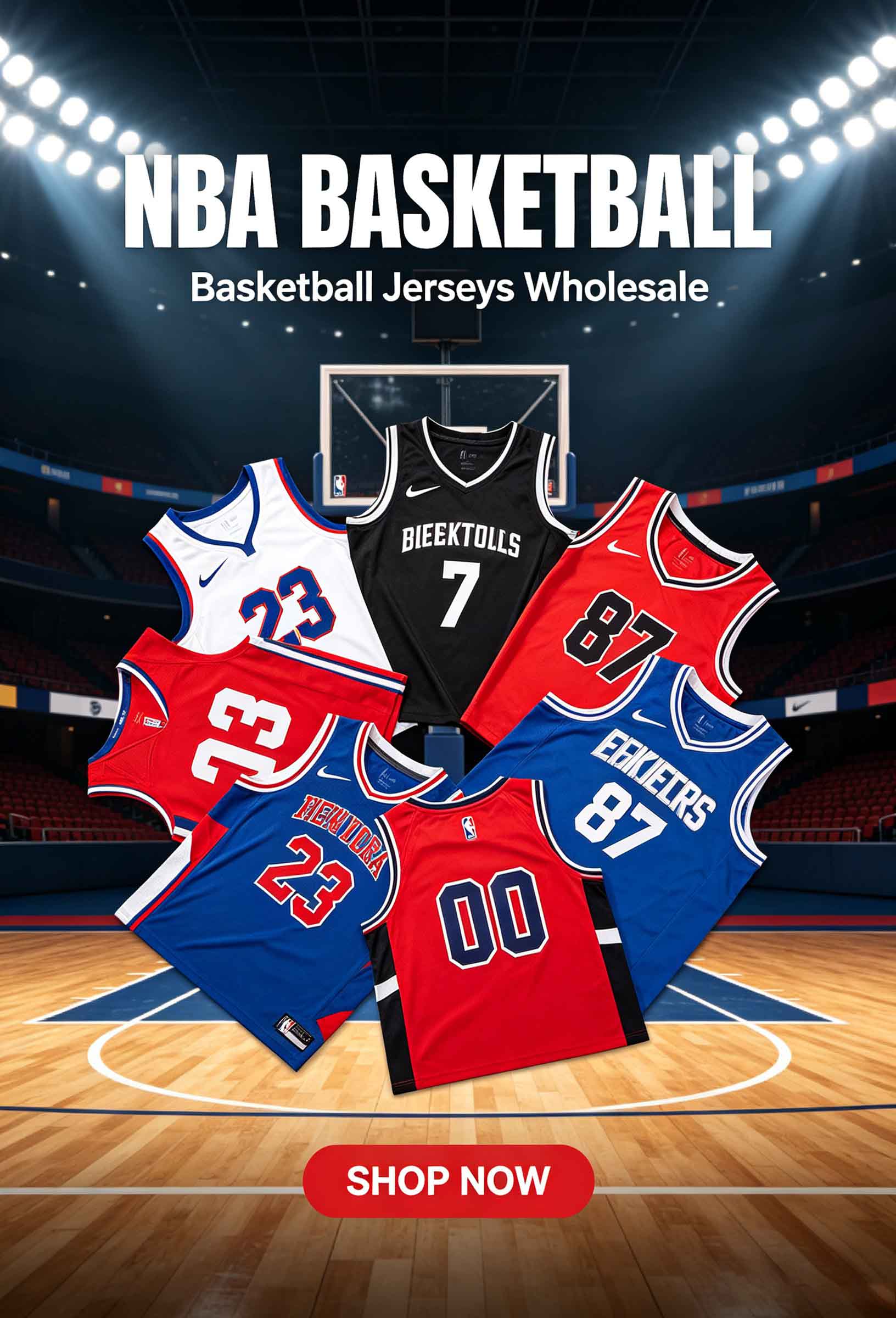
Buying custom made baseball jerseys bulk should not mean juggling six vendors, six freight quotes, and six different definitions of the word "stitched." Most team apparel buyers and league managers bleed margin long before the jerseys reach the dugout — split shipments stack up, dye lots come in two shades of navy, and half the size run lands on backorder three weeks before opening day.
Jerseys Wholesale Hub solves that with one warehouse, one QC standard, and one freight lane. Every order pulls from live stock, gets inspected against the same measurement sheet, and ships consolidated so you pay one shipping bill instead of five.
The Hub carries button-down baseball silhouettes in the full professional cut: full-button front placket, set-in sleeves, and a straight hem. Size runs cover youth S through XL and adult S through 5XL, plus tall bodies on core colorways. If your league order spans eight-year-olds and forty-year-old coaches, that range lives in the same building.
Fabric is where most budget suppliers cut corners, so we start there. Our standard body is 100% breathable polyester mesh, knit with open air channels that move heat off the chest during doubleheaders. For practice sets and heavy-use team uniforms, ask for the 300 GSM heavyweight mesh build — it holds shape through a full season of wash cycles and resists the sagging that shows up on 150 GSM imports by week six.
Lettering and numbers are where resellers get burned most often. Our numbers are double-stitched Tackle Twill, layered twill with a satin-stitch border, not a printed patch glued on and hoped for. Sew-outs sit flat, edges stay down after washing, and the stitch density is consistent from the first jersey in the run to the four hundredth.
Inside the jersey, we add a soft interior backing behind the twill so the embroidery never scratches a player's back through a thin undershirt. Collars use reinforced collar bands with a taped neck seam, and stress points at the shoulder and placket corners get Z-stitch reinforcement. These are the details that decide whether a uniform survives one season or four.
- Body fabric: 100% breathable polyester mesh, 180–200 GSM standard or 300 GSM heavyweight
- Numbers & letters: double-stitched Tackle Twill, layered, satin-stitch bordered
- Interior: soft backing cloth behind all embroidery
- Collar: reinforced band with taped neck seam
- Front: full button placket, box-stitched button anchors
- Sizing: youth S–XL, adult S–5XL, tall bodies on core colors
Customization runs past names and numbers. Chest logos can be done as embroidered patches, twill appliqué, or woven labels depending on how bold the mark is. Sleeve patches, memorial bands, and sponsor plates are all standard add-ons. Just be clear about the method: stitched and embroidered work holds value for years, while heat-pressed vinyl peels at the corners after a dozen hot washes.
If your buyers want sublimated designs instead, that option exists too — full-color sublimation makes sense for complex gradients and practice pinnies where every unit looks identical. For licensed-look team uniforms and anything a collector will resell, stitched construction wins on perceived quality every time.
- Choose Tackle Twill / embroidery: retail-facing team uniforms, throwback styles, resale inventory
- Choose sublimation: high-volume practice sets, multi-color graphics, tight per-unit budgets
- Choose heat press: only for one-off samples or short-term promo runs
When you source through a hub instead of individual factories, the ordering mechanics matter as much as the product. Ask for mixed-size cartons rather than solid-size cases — a league order of 240 pieces rarely breaks evenly across sizes, and solid packs leave you sitting on twelve extra 3XL bodies.
That is the practical reason buyers consolidate here: one purchase order covers the full roster, one inspection report covers the full shipment, and one freight cost lands at your dock. You can review the current run of custom made baseball jerseys bulk stock and tier breaks before you commit a single dollar.
Quality control at the Hub follows a documented sampling standard rather than a glance in the warehouse. Incoming lots are pulled at AQL 2.5, with cartons sampled from the top, middle, and bottom of each pallet — not just the top layer that was packed last.
- Chest width: measured 1 inch below the armhole, tolerance ±0.5 inch
- Body length: measured from high point of shoulder, tolerance ±0.75 inch
- Number height: checked against the spec sheet on front and back
- Number alignment: centered on the back panel, checked against the placket
- Stitch count: minimum density verified on Tackle Twill borders
- Colorfastness: wash-tested sample checked for bleeding and fading
Run the same checks on your end when the pallet arrives. Pull three jerseys at random, measure them, and compare. If a supplier's size chart drifts between shipments, that is a manufacturing discipline problem, and it shows up as returns from your retail customers.
Sizing trips up more wholesale buyers than anything else. A baseball jersey is cut to layer over a tee, so a player who wears a medium t-shirt usually wants a medium jersey for a fitted look or a large for a relaxed one. The most reliable method is to measure a jersey the team already owns: lay it flat, measure armpit to armpit, and double it. Match that number to the Hub's size chart rather than guessing from letter sizes.
Care instructions are worth printing on the hangtag, because how a jersey is washed decides how long it looks new. Turn it inside out, wash cold on a gentle cycle, skip the fabric softener, and hang it to dry. If a customer insists on ironing, tell them to iron the reverse side on low heat and never press the iron directly onto twill or embroidery — the heat flattens the stitch loft and can scorch polyester.
Margin math is straightforward once freight is consolidated. Split your landed cost into three lines: unit price at your tier, inbound freight divided by units, and packaging. When those three drop because everything ships together, your per-jersey cost falls without touching retail price. Tier breaks reward volume, but the bigger win for most resellers is eliminating the second and third shipment.
Timing matters too. League buyers order in late winter and early spring, school programs order in summer, and tournament sellers order in short bursts. Hub stock is held year-round with rapid pull times, so a restock in June does not mean waiting on a production slot in another time zone.
How long does bulk custom production take? In-stock blank builds with standard number sets move in days; full custom rosters with names, numbers, and patches take longer and depend on artwork approval turnaround. Send clean vector files and the clock starts faster.
What is the minimum order? The Hub keeps MOQ low enough for single-team orders and small pro shops, while still opening tier pricing at higher volumes. Mixed-size and mixed-color cartons count toward the same tier.
Can I mix baseball and other sports in one shipment? Yes. Football, basketball, hockey, and baseball inventory ships from the same facility, which cuts freight on multi-sport buyers considerably.
Do you provide size charts and spec sheets? Every product line has a measurement sheet with tolerances. Request it before placing a large order and check it against a physical sample if your budget allows.
Stop paying three vendors for one roster. Review live inventory, tier pricing, and dispatch windows at www.jerseyswholesalehub.com — one hub, full size runs, Tackle Twill construction, and consolidated freight. Browse the full MLB jersey catalog and lock your season order before the size runs thin.